
By Macey Wurm
Nestled between two neighborhood homes in the Central District, Cherry Street Farm and its cultivators tell a story of community and passion centered around health and wellness.
Cherry Street Farms originally opened in 2021 as an extension of Hip Hop Is Green, a Seattle-based nonprofit working to bring “holistic wellness and the survival of Black, Indigenous, and People of Color” to the forefront of hip hop culture.
Thanks to Hip Hop Is Green’s founder and executive director, Keith Tucker, health and wellness was formally recognized as an element of hip-hop in 2016.
As described by Tucker, hip hop culture had nine defining elements outlined by the Hip Hop Declaration of Peace signed by the United Nations on May 16, 2001. These were break dancing, emceeing, graffiti art, deejaying, beatboxing, street fashion, language, knowledge, and entrepreneurship. Tucker proposed health and wellness as the tenth element, and it was eventually added and commemorated with a signing ceremony involving hip hop legends at Harlem’s Schomburg Center for Research in Black Culture.
Long before the ceremony and the opening of Cherry Street Farm, Tucker was already putting in the work to integrate hip hop and veganism. He organized his first “Hip Hop is Green Dinner” in 2009 in collaboration with Stuart Rose, the co-founder of Vegetarians of Washington.
“And this is the time where the vegan industry, as far as the products that we see now, all that stuff was really in its infancy. And so I came along with that idea at the right time.” Tucker said.
Rose provided the food while Tucker provided the music and the crowd. Tucker eventually took this event on the road, hosting Hip Hip is Green dinners throughout the country.
“It was always a joy for me to go out there, expose kids to the food. And parents would come up to me and be like, ‘ Keith, I took my daughter to your event and she’s been vegan for like three years now.’ I made a mental note in my head that our events can actually change somebody’s life in two hours.” Tucker explained.
The COVID-19 pandemic ultimately led Tucker to switch gears to focus more on what urban farms could look like in the United States.
Now, Tucker has established a space to nurture health and wellness right in his backyard–a farm property belonging to his family since 1964, and neighboring his childhood home.
Since 2021, Cherry Street Farm’s 5,000-square-foot lot has housed an inconspicuous, 40-foot-long shipping container out of which operates a hydroponics lab capable of growing the equivalent of 2.5 acres of food. The system is completely soilless, with plants gaining nutrients and water from drip systems. The lab uses around only six gallons of water per day.
As explained by one of Hip Hop is Green’s plant-life cultivators, Julianna Bernado, seeds begin in grow plugs in the nursery. After reaching a certain size, the plants are transported to the permanent cultivation area. On average, employees harvest 50-70 pounds of produce a week. A variety of plants including microgreens, flowers and leafy greens are grown year-round.
The lab has been the long-standing star of the farm, serving as a supplier to local hospitals, restaurants and the nearby Byrd Barr Place’s foodbank called “The Market.” Named after civil rights leader Roberta Byrd Barr, the organization provides energy assistance, financial and community resources to the Central District.
Tucker’s long-term vision, however, is centered around youth — educating local kids about home-farming practices, vegan cooking and environmental-job opportunities.
This vision will manifest as a reciprocal relationship between the facility’s new outdoor planting beds and its kitchen currently under construction. Hip Hop Is Green’s Youth Excellence Program will teach outdoor farming and harvesting practices, and help young people adapt food resilience into their home lives.
“Part of food resilience is separating ourselves from the overarching systems that put us in this position; so teaching students how to grow food at home is an important part of that,” Bernado said. They will also learn to cook healthy, green-centered meals just feet away after the kitchen is complete.
The Youth Excellence program is a climate-change educational program and paid internship that provides “interactive learning about plant-based food” according to Hip Hip is Green’s website.
It includes climate change education, green career readiness and food justice. The program takes place over 10 weeks in the summer and also has four bootcamps. Last year, the program was awarded $85,277 as a part of the Seattle Office of Sustainability and Environment’s Environmental Justice Fund. The program has graduated over 400 kids since it started in 2021.
“Be sustainable and grow your own food.” Tucker says. “You know, don’t worry. Don’t let corporations feed you. You can feed your own self.”
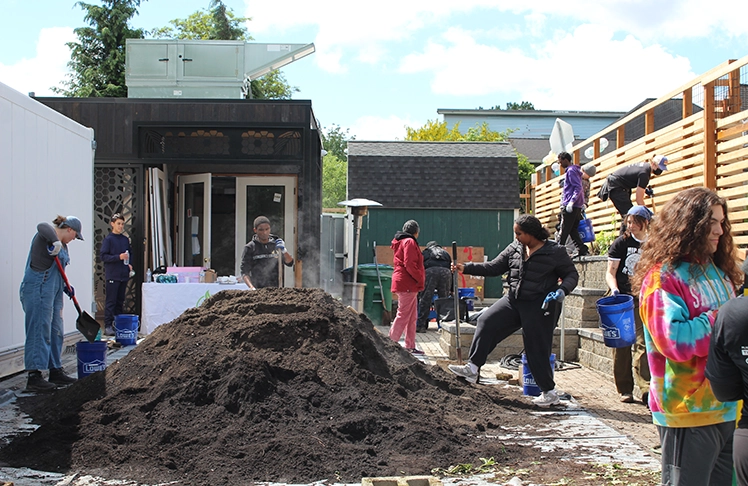
On Saturday, May 16, Cherry Street held a planting party to mulch and seed the facility’s new raised outdoor planting beds for the season.
“It’s just so beautiful to see where we’re at. Even planting plants here is a dream come true.” said Tina Petrusha, one of the instructors for the organization’s Youth Excellence Program.
Petrusha worked as a history teacher for seven years before joining Hip Hop is Green’s teaching staff in 2023. She was searching for a way to impact young people in a more fulfilling way. “All these creative things based on community and giving and health and wellness– that’s huge.”
The party commenced at 10 a.m. as volunteers, staff and students gathered for friendly introductions and stretching. Bernardo gave some important safety notices before everyone was invited to grab a tool, and get to mulching. Most important was taking care of one’s body in light of the work to be done, she said.
But it wasn’t all work. A speaker on the table blasted hip-hop hits like Kendrick Lamar’s “Alright” and Lupe Fiasco’s “Kick, Push,” while more student volunteers, families, and friends filed in, and familiar smiling faces gathered around for photos.
Teen-age volunteers Benji, Hassan, and Hassan’s younger brother, Daud, worked as a team in the corner, joking around. The trio asked for a photo and admitted that they were having a good time. One of the students, Hassan, has been working with Hip Hop Is Green for two and a half years. This year, he finally gets to be a mentor for the Youth Excellence Program.
“This is my first day working for Hip Hop Is Green,” said Benji. ”It’s definitely a great vibe. There’s music going and there’s gonna be pizza soon and I’m really happy to be here.”
The crew planted an array of produce, including peas, carrots, tomatoes, collard greens and herbs. On the other side of the property, others planted raspberry bushes.
Tucker is planning a grand opening on June 22 for the newly done space, including the patio, planter beds, kitchen, and bee sanctuary. The event will coincide with the seventeenth anniversary of Hip Hop is Green. But Tucker’s plans won’t be stopping with this site. To him, this is just the beginning.
“It’s gonna have to be a whole revolution of all this stuff if there is going to be a future for the next two or three generations. I’m going to redesign what urban farms are in America, because I want to feed kids, I want to feed the community, I want to teach kids how to grow food, and I want to do it 365.”